Post-Quantum HTTP 402 Settlement for Autonomous AI Agents: Go 1.27 FIPS 203/204 Benchmarks & 1-Block Kill-Switch
Autonomous agents are moving from read-only assistants to metered economic actors invoking paid MCP tools, vector search APIs, and verification oracles over HTTP 402 (x402). When we engineered NyxSynth (NYX), we focused on two structural gaps in today's agent-payment stacks:
- Unconstrained hot keys: Handing an agent a raw signing key lets a single prompt injection or runaway loop drain an entire wallet before an off-chain circuit breaker reacts.
- Elliptic-curve fragility: Classical ECDSA and Ed25519 keys exposed on long-lived ledgers and encrypted P2P channels remain vulnerable to harvest-now-decrypt-later collection and Shor-class breaks.
To address both at the protocol layer without introducing third-party supply-chain bloat, we built the Bioluminescent Coordination Protocol (BCP) around a zero-dependency Python 3.12 stdlib core paired with a compiled Go 1.27 constant-time NIST FIPS 203/204 cryptographic sidecar.
platform.nyxsynth.com and explorer.nyxsynth.com currently runs in Public Testnet
mode (testnet NYX has zero monetary value). Value-bearing Mainnet remains gated by MainnetLaunchGate
pending independent external cryptography/consensus audits and multi-operator soak testing.
1. Process Boundary: Zero-Dep Python 3.12 Core ↔ Go 1.27 PQC Sidecar
Rather than embedding C extensions inside CPython or implementing pure-Python lattice arithmetic with timing
leaks, we isolate all lattice and key-committing AEAD operations inside a persistent compiled Go 1.27 binary
using Go's standard library (crypto/mldsa, crypto/mlkem, crypto/aes,
crypto/cipher, crypto/sha3, crypto/subtle):
+---------------------------------------------------------------------+
| NyxSynth Node (Python 3.12 stdlib only — zero third-party deps)     |
| - 2-Phase TLA+-verified BFT + Kuramoto Torpor energy throttling     |
| - Atomic SQLite WAL consensus lock & exact integer uNYX (1e-6)      |
| - Consensus-enforced AgentSessionMandate + 1-block kill-switch      |
| - Native HTTP 402 (x402) Hadal micro-rollup compressor (70/20/10)   |
| - Float-free W3C WebAssembly 1.0 SymbioticVM                        |
+----------------------------------+----------------------------------+
                                   | Synchronized persistent IPC
+----------------------------------v----------------------------------+
| Compiled Go 1.27 Constant-Time Cryptographic Sidecar                |
| - NIST FIPS 203: ML-KEM-768 / ML-KEM-1024 P2P key encapsulation     |
| - NIST FIPS 204: ML-DSA-65 stateless signatures (3,309 B)           |
| - XMSS^MT Bio-WOTS+ stateful hash-based vault option                |
| - BioAEAD GCM2: Key-Committing AES-256-GCM                          |
+---------------------------------------------------------------------+
2. Measured Go 1.27 Sidecar & WASM 1.0 Benchmarks
Every figure below was measured across 300 consecutive iterations over the warmed persistent
Python-to-Go IPC channel alongside our float-free W3C WebAssembly 1.0 oracle
(mcp-x402-wasm-prover). Engineers can also run our standalone pure-Go 1.27 verification and
benchmark suite directly from github.com/NyxSynth/nyxsynth-pqc-x402-bench.
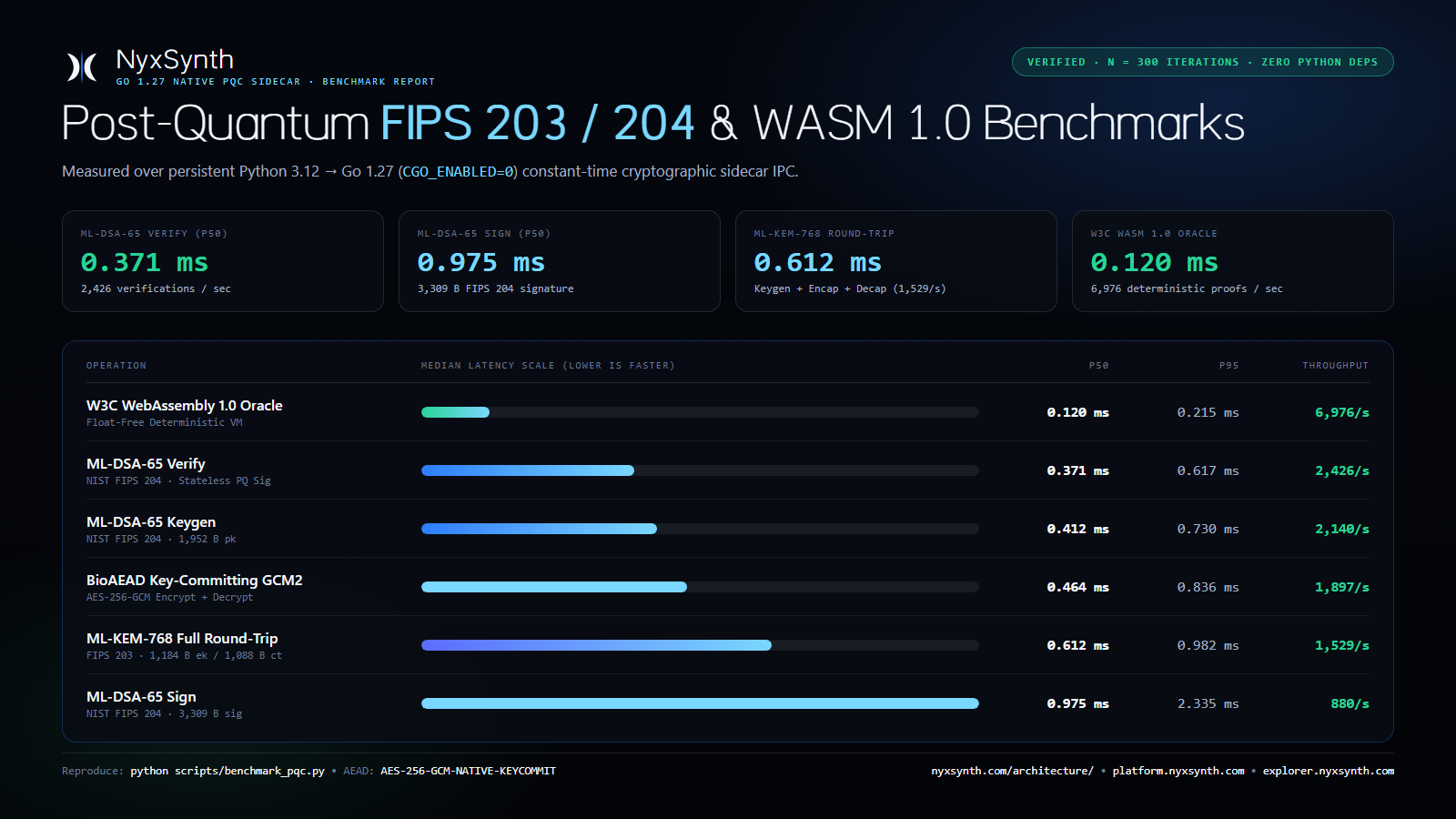
| Primitive | p50 Latency | p95 Latency | Throughput | Artifact / Spec |
|---|---|---|---|---|
| W3C WebAssembly 1.0 Oracle (Float-Free) | 0.120 ms | 0.215 ms | 6,975.9 ops/s | Deterministic gas |
| ML-DSA-65 Verify (NIST FIPS 204) | 0.371 ms | 0.617 ms | 2,425.6 ops/s | 3,309 B signature |
| ML-DSA-65 Keygen (NIST FIPS 204) | 0.412 ms | 0.730 ms | 2,140.3 ops/s | 1,952 B public key |
| BioAEAD Key-Committing AES-256-GCM | 0.464 ms | 0.836 ms | 1,896.8 ops/s | GCM2 Enc + Dec |
| ML-KEM-768 Round-Trip (NIST FIPS 203) | 0.612 ms | 0.982 ms | 1,529.3 ops/s | 1,184 B ek / 1,088 B ct |
| ML-DSA-65 Sign (NIST FIPS 204) | 0.975 ms | 2.335 ms | 879.6 ops/s | 3,309 B signature |
3. Consensus-Enforced Agent Guardrails & 1-Block Kill-Switch
We separate offline master custody from delegated agent execution directly inside validator state transition rules:
- Offline Master ML-DSA-65 Vault: Signs an
AgentSessionMandatebinding an ephemeral agent session key to hardmax_total_spend,max_per_tx, explicitallowed_recipients, andexpiry_height. - Validator-Level Enforcement: Even if an agent runtime is fully prompt-injected or compromised, over-cap or non-allowlisted spends fail consensus validation.
- 1-Block Emergency Kill-Switch: Broadcasting
AGENT_MANDATE_REVOKEsigned by the master key permanently invalidates the session across all validators in a single finalized block (verified live on testnet TXba07e80d600c6beb).
4. Compressing 3.3 KB ML-DSA-65 HTTP 402 Vouchers via Hadal Micro-Rollups
NIST FIPS 204 ML-DSA-65 signatures are 3,309 bytes each. Putting every sub-cent API
call directly on L1 would amplify block bandwidth quickly. Our 4-stage HTTP 402 pipeline verifies scoped
vouchers off-chain and commits compressed net deltas via HadalMicroRollup (achieving
2.5x compression on 5-call bursts in our live playground, e.g. TX f723f1c5753a7b77),
splitting exact integer uNYX fees deterministically 70% validators / 20%
permanent burn / 10% treasury.
5. Formal Safety & 99.15% Torpor Energy Savings
Our 2-phase BFT lock/unlock and view-change invariants are exhaustively model-checked across
12,192 reachable TLA+ states, while Kuramoto phase-locked Torpor duty-cycling
(R = 0.9994 on our live cluster) eliminates idle proof-of-work waste with
99.15% energy savings.